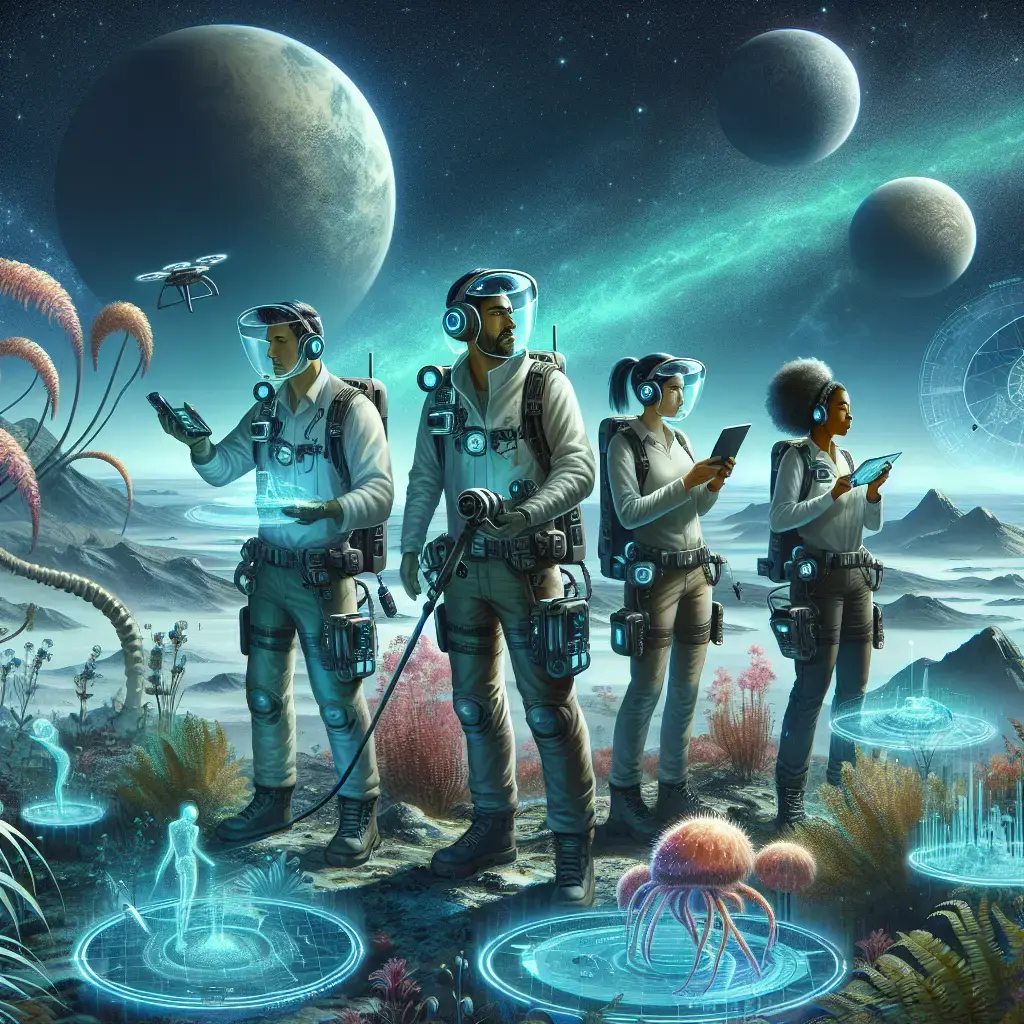
Are we alone in the universe? This age-old question continues to intrigue scientists and enthusiasts alike.
Astrobiology, the study of life beyond Earth, seeks to unravel this mystery, delving into the possibilities of life among the stars. Recent studies suggest that intelligent alien life may be rarer than we previously imagined, offering new insights and perspectives into the cosmic puzzle.
The Drake Equation Revisited
At the heart of this inquiry lies the famous Drake equation, a tool used by scientists to estimate the number of active, communicative extraterrestrial civilizations in the Milky Way galaxy. Traditionally, the equation considers several variables, including the rate of star formation and the fraction of those stars with planetary systems. However, a recent study has revamped this equation using probabilistic logic, painting a more complex picture of the cosmos.
- Probabilistic Logic: This approach allows for a nuanced understanding by incorporating uncertainties and variabilities in each factor of the equation. It suggests that the universe could either be teeming with life or almost devoid of it, with significant implications for our search for extraterrestrial intelligence (SETI).
Why Haven't We Found Them?
One compelling question arises from this study: if intelligent life is out there, why haven't we found any evidence of its existence? The researchers propose that if advanced civilizations did exist, they might have vanished long ago. Their technological signatures could have decayed over time, leaving us with no trace of their existence.
Temporal Factors: The lifespan of technological civilizations might be shorter than anticipated due to self-destruction or natural catastrophes. This would mean that the window for detecting these civilizations is incredibly narrow.
Cosmic Loneliness: Alternatively, it could be that intelligent life is exceptionally rare and our solar system is an outlier in a vast and silent galaxy.
The Implications for Astrobiology
This study challenges our perceptions and encourages astrobiologists to rethink their strategies for discovering extraterrestrial life. It underscores the importance of:
Expanding Our Search Parameters: By exploring more than just radio signals, including potential bio-signatures on exoplanets.
Emphasizing Planetary Defense: Understanding our own fragility as a technological civilization can guide efforts to preserve humanity.
Exploring New Frontiers: As we venture into deep space exploration, each discovery offers clues about life's potential beyond Earth.
In Conclusion
The quest to determine whether we are alone in the universe continues to drive scientific inquiry and imagination. While this recent study suggests that intelligent alien life may be rare, it also highlights the profound impact such a discovery would have on our understanding of life's place in the cosmos.
As we journey through the stars in search of answers, let's remain hopeful yet realistic about the possibilities that await us in this vast universe.
For more details on this study and its implications, you can visit the article here.
With each step we take into the cosmic unknown, we affirm our desire to connect with something greater than ourselves. Until next time, keep gazing at the stars and wondering about the mysteries they hold.
Author: Harper Bennett